.png)
Introduction
AI is transforming healthcare, agriculture, finance, education, and government. As organizations adopt increasingly powerful AI models, they often rely on benchmark leaderboards and performance metrics to guide their decisions.
But one question remains:
Can an AI model with impressive benchmark scores actually be trusted in the real world?
Problem
Most AI evaluations focus on technical performance; accuracy, reasoning ability, and benchmark scores. While these metrics show what a model can do, they do not reveal whether it is safe, secure, fair, compliant, or ready for deployment.
An AI model can achieve excellent benchmark results yet still produce biased outputs, expose sensitive data, or fail under real-world conditions. As AI becomes embedded in critical systems, evaluating performance alone is no longer enough.
What You'll Learn
In this article, you'll learn:
- Why benchmark scores alone are insufficient.
- What AI assurance is and why it matters.
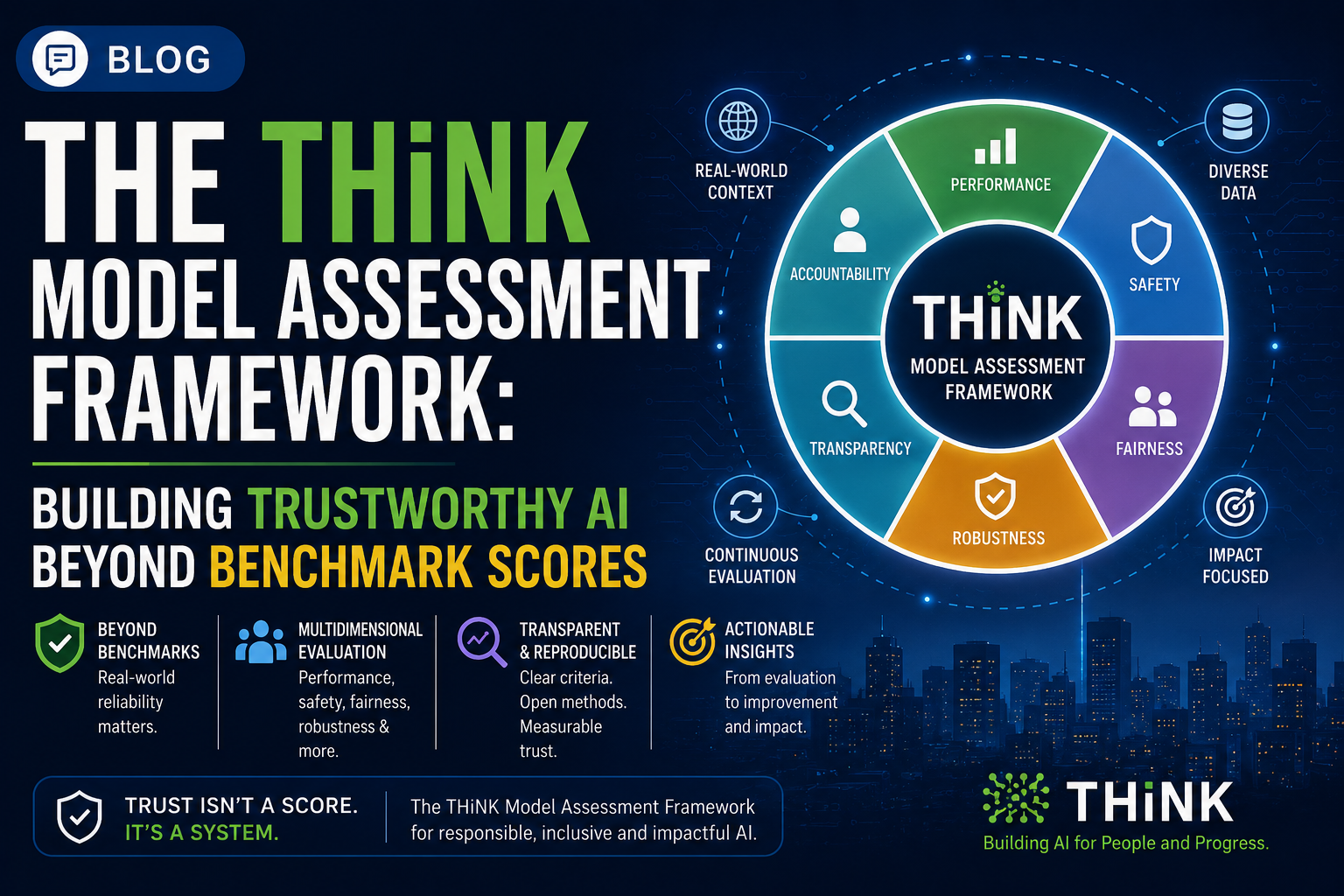
- How the THiNK Model Assessment Framework provides a more comprehensive way to evaluate AI.
Background
AI has evolved rapidly from traditional machine learning to large language models, multimodal systems, and agentic AI capable of reasoning, planning, and using external tools.
Frameworks such as the NIST AI Risk Management Framework, ISO/IEC 42001, and the OECD AI Principles provide valuable guidance for responsible AI. However, they do not fully answer one practical question:
How do we know whether a specific AI model is trustworthy enough to deploy?
This is where AI assurance becomes essential.
Looking Beyond Benchmark Scores
Technical benchmarks remain valuable for comparing AI models, but real-world deployment requires much more than high scores. Organizations also need to understand whether an AI model is:
- Fair and unbiased
- Secure against cyber threats
- Protective of sensitive data
- Transparent and explainable
- Compliant with regulations
- Reliable in production
Without assessing these areas, benchmark scores provide only part of the picture.
Example
Imagine two AI assistants with nearly identical benchmark scores. One has undergone security testing, fairness assessments, governance reviews, and continuous monitoring. The other has only been evaluated for technical performance.
Although both appear equally capable, the first provides far greater confidence for deployment in sectors such as healthcare, banking, or government.
AI Assurance: A More Complete Way to Evaluate AI
AI assurance expands the evaluation process beyond "How well does this model perform?" to ask a more important question:
"Can this model be trusted in the environment where it will operate?"
The THiNK Model Assessment Framework answers this through a holistic methodology that evaluates AI models across twelve complementary domains, including:
- Technical Performance
- Benchmark Evaluation
- Human Evaluation
- Responsible AI
- Safety
- Agentic AI
- Security and Privacy
- AI Governance
- Compliance
- Operational Readiness
- Production Monitoring
- AI Assurance
Together, these domains provide a comprehensive view of an AI model's strengths, risks, and readiness for deployment. Rather than replacing existing standards, the framework translates responsible AI principles into measurable assessment activities.
Example
A customer service chatbot may perform exceptionally well during testing, yet still expose confidential information, produce unsafe responses, or lack monitoring once deployed. Traditional benchmarks may never detect these risks—but AI assurance can.
Trustworthy AI Requires Continuous Assessment
AI evaluation is not a one-time exercise. Models evolve through fine-tuning, new data, software updates, retrieval augmentation, and changing operating environments, introducing new risks over time.
The THiNK Model Assessment Framework therefore adopts a lifecycle approach that emphasizes continuous monitoring, periodic reassessment, evidence gathering, and independent verification.
One key outcome is the THiNK Trust Score; an evidence-based measure that reflects not only how capable an AI model is, but also how safe, secure, governable, resilient, and deployment-ready it is.
Example
When evaluating AI vendors, procurement teams often compare benchmark scores. Adding a Trust Score enables them to also compare governance maturity, security posture, operational readiness, and responsible AI practices, leading to better-informed decisions.
Practical Takeaways
- Don't rely on benchmark scores alone. Performance is only one dimension of trustworthy AI.
- Evaluate AI holistically. Assess governance, safety, fairness, security, compliance, and operational readiness alongside technical capability.
- Make AI assurance continuous. Regular reassessment helps identify emerging risks as AI systems evolve.
Conclusion
Artificial Intelligence is becoming a foundational technology across governments, businesses, and society. As AI systems grow more capable and autonomous, organizations must move beyond traditional performance metrics when evaluating them.
Trustworthy AI is defined not only by intelligence, but by how responsibly, safely, securely, and reliably that intelligence can be deployed.
The THiNK Model Assessment Framework provides an evidence-based approach to AI assurance by combining technical evaluation with governance, security, compliance, operational readiness, and continuous monitoring. This enables organizations to make better deployment decisions while reducing risk and building confidence in AI.
The future of AI will not be shaped only by the most powerful models—it will be shaped by the models we can confidently trust.
Call to Action
As AI adoption accelerates, now is the time to rethink how we evaluate AI systems. If your organization is developing, deploying, or procuring AI solutions, move beyond benchmark scores and embrace a holistic AI assurance approach.
The THiNK Model Assessment Framework provides a practical pathway to evaluating AI systems that are not only powerful, but also trustworthy, accountable, and ready for the real world.