.png)
Let's be honest—AI is everywhere.
Whether it's a bank using AI to detect fraud, a hospital improving patient care, or a business using ChatGPT to boost productivity, organisations across Kenya are embracing AI faster than ever before.
But here's the question very few are asking:
How do you know you're using AI responsibly?
It's easy to adopt AI. It's much harder to govern it.
Most organisations don't lack enthusiasm—they lack a roadmap. They know AI can transform their operations, but they're unsure how to manage risks, ensure accountability, protect data and build trust along the way.
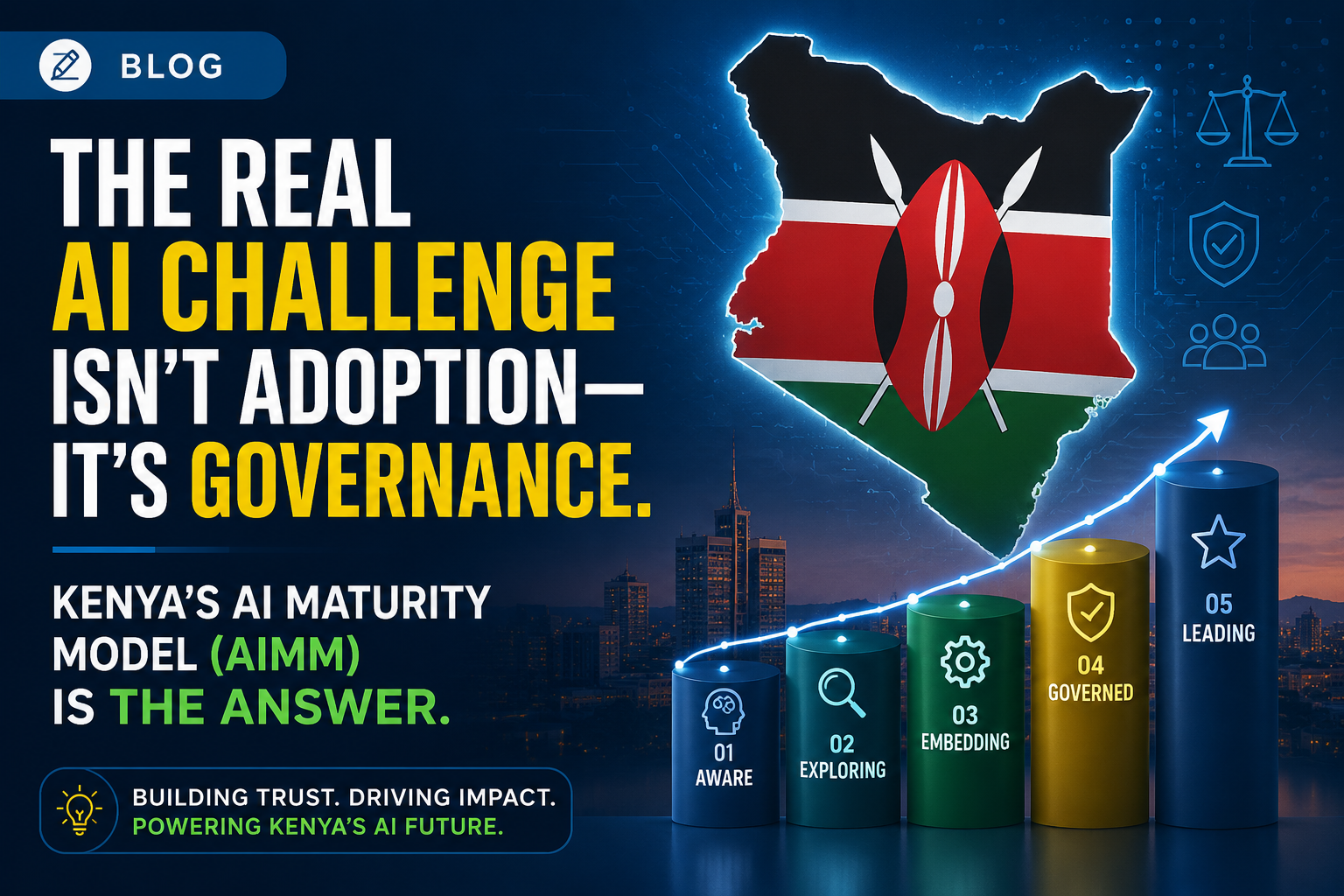
That's exactly why the Kenya AI Maturity Model (AI-MM) was developed.
Why Isn't Having AI Enough?
Imagine building a house without a blueprint.
You might end up with something that looks impressive, but beneath the surface, cracks begin to appear.
AI works the same way.
Without proper governance, even the most powerful AI system can create unintended risks—from biased decisions and privacy concerns to regulatory and reputational challenges.
The AI-MM addresses this challenge by giving organisations a structured way to assess where they are today and what they need to improve to adopt AI responsibly. It translates the principles in KS 3007:2025 and ISO/IEC 42001:2023 into practical steps organisations can follow.
Think about it: Would you rather discover governance gaps after an AI system fails, or identify and fix them before they become costly problems?
So, What Makes the AI Maturity Model Different?
The AI-MM doesn't expect every organisation to be perfect from day one.
Instead, it asks a much simpler question:
"Where are you today?"
Using ten governance pillars and a five-level maturity scale, the framework helps organisations measure their current AI governance capability, identify gaps and create a realistic improvement plan.
For example, a county government deploying AI to improve citizen services won't have the same governance responsibilities as a technology company developing AI models. The AI-MM recognises these differences and provides guidance that reflects each organisation's role.
Why Does This Matter for Kenya?
Kenya isn't just adopting AI—we're shaping how AI will be used across Africa.That means we have an opportunity to lead, not only in innovation but also in responsible AI governance.
The AI-MM is built specifically for Kenya. It aligns with the Kenya National AI Strategy and incorporates local legal and regulatory requirements, including the Data Protection Act, making it practical for organisations operating within our national context.
In other words, it isn't another international framework copied and pasted into Kenya.
It's Kenya's roadmap for responsible AI.
What Can Your Organisation Do Today?
You don't need to have all the answers.
You simply need to start asking the right questions.
- Do we know our AI governance maturity?
- Are we managing AI risks consistently?
- Are our AI systems transparent and accountable?
- Do we have a plan for continuous improvement?
If the answer to any of these questions is "not yet", the AI-MM provides a clear place to begin.
Conclusion
AI is changing how we work, serve customers and deliver public services.But adopting AI is only half the journey.
The organisations that will succeed in the long term won't necessarily be those using the most AI—they'll be the ones using it most responsibly.That's why the Kenya AI Maturity Model matters.
It gives organisations the confidence to innovate, the structure to govern AI effectively and the roadmap to build trust every step of the way.
So, where is your organisation on its AI governance journey?
The Kenya AI Maturity Model (AI-MM) is more than a framework—it's a practical guide to helping organisations assess, improve and confidently embrace responsible AI.
Written By:
THiNK Lab Lead