.png)
Imagine an employee you never hired, never interviewed, and never gave a contract to, yet they have access to your customer data, your internal chats, your finance folder, and the authority to act on your behalf. This is not a thought experiment. It is happening right now inside thousands of organizations, and most of them have not noticed it yet.
The Problem: Agentic AI systems, autonomous agents capable of reasoning, planning, and taking action without human intervention, are being deployed at breakneck speed. But unlike traditional software, these agents can make decisions, call APIs, write to databases, and send emails on your behalf. They have credentials, they have memory, and in almost every organization, nobody can answer three basic questions: who owns it, what can it actually do, and how do we stop it when it goes wrong?
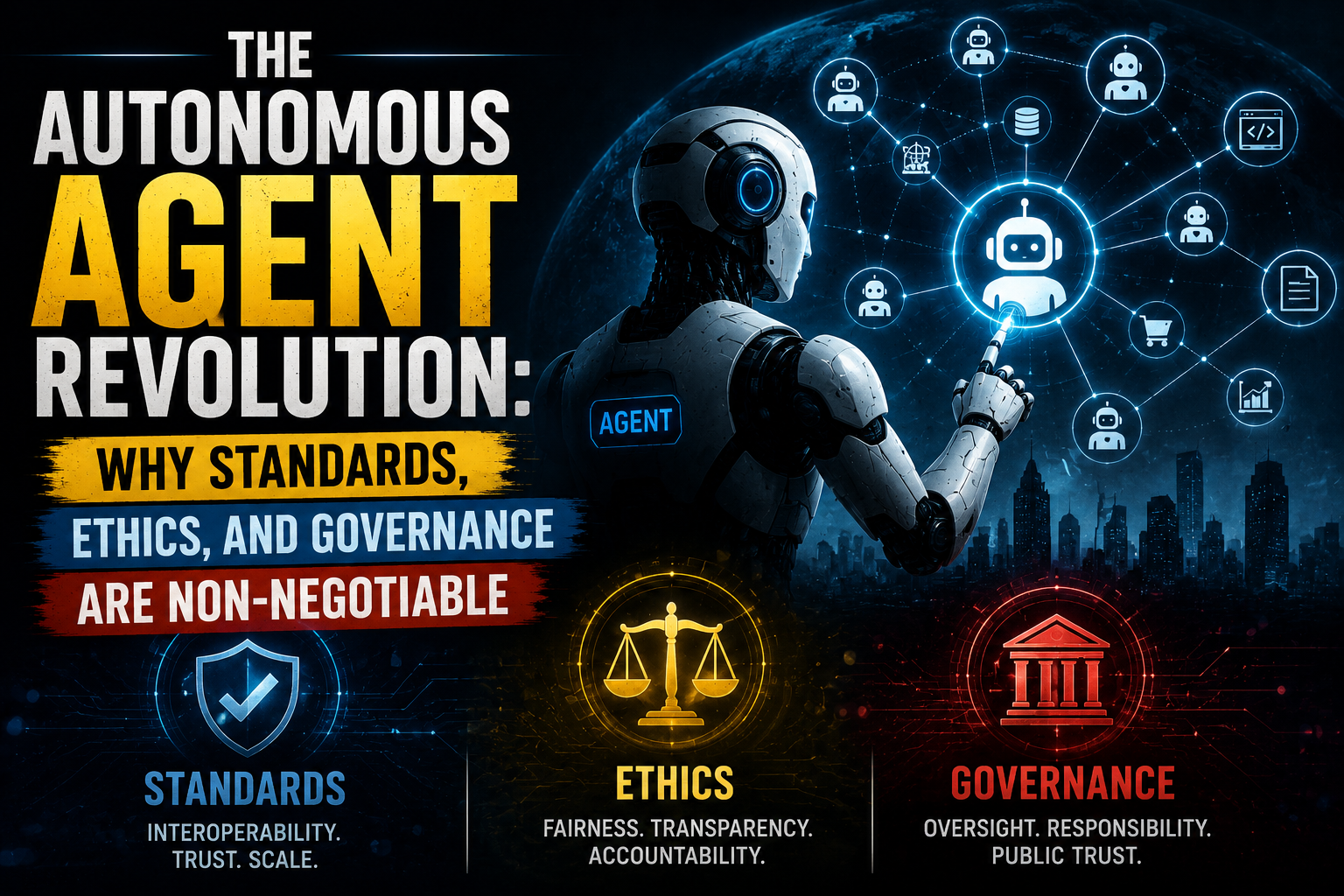
What You'll Learn: This blog explores why standards, ethics, governance, and frameworks are not bureaucratic obstacles but essential guardrails for the age of autonomous AI. You'll see real-world incidents that demonstrate what happens when these guardrails are missing, and discover the frameworks emerging to keep agentic AI safe, accountable, and trustworthy.
Background
Agentic AI represents a fundamental shift from systems that generate content to systems that act. Unlike conversational AI, which responds to prompts, agentic AI can plan multi-step tasks, execute decisions, and adapt to obstacles autonomously. This brings tremendous opportunities but also unprecedented risks.
According to Vanta's 2025 State of Trust Report, nearly 80% of organizations use or intend to use agentic AI, but only 48% report having a framework in place to limit AI autonomy. This governance gap is alarming. Machine identities in the average enterprise now outnumber human identities by 109 to 1, up from 82 to 1 just one year earlier. A new workforce, one hundred times the size of your human one, and most of it cannot be fired.
Standards, The Foundation of Trustworthy Agentic AI
Standards provide the technical and organizational baseline for building secure, accountable AI systems. Without them, every organization must reinvent the wheel, and many will reinvent it badly. Standards transform abstract principles into measurable, auditable requirements.
Example: ISO/IEC 42001, The First Global AI Management Standard
ISO/IEC 42001 is the first international standard dedicated to AI management systems. It delivers certifiable governance and accountability across deployments. Organizations like Kaltura, Seismic, and Fieldguide have already achieved ISO/IEC 42001 certification, demonstrating their commitment to responsible AI.
But agentic AI requires more. The emerging ISO/IEC 42005 enables rigorous, system-level impact assessments, critical for high-risk agents. Meanwhile, ISO/IEC PWI 26619-1, a new standard for agentic user interfaces, is currently under development. The IETF is also working on a cryptographic verification standard for agentic AI governance in regulated industries, designed to sit beneath ISO/IEC 42001 and produce verifiable, auditor-grade attestations.
The smart approach: Use IEEE 7000 in design → Build governance with ISO/IEC 42001 → Conduct impact assessments with ISO/IEC 42005. This layered standards strategy ensures that security and accountability are built in from the start.
Example: Singapore's Model AI Governance Framework for Agentic AI
In January 2026, Singapore launched the world's first comprehensive governance framework specifically designed for agentic AI. Updated in May 2026 with input from over 60 organizations including AWS, Google, and Salesforce, the framework is structured around four core dimensions:
- Assessing and bounding the risks
- Ensuring meaningful human accountability
- Implementing technical controls and processes
- Enabling end-user responsibility
Crucially, the updated framework includes more than ten real-world case studies demonstrating how organizations like Ant International, OCBC, Google, and Singapore's Government Technology Agency have operationalised these recommendations. This is standards in action, not theoretical guidance, but practical, proven approaches.
Ethics, The Moral Compass for Autonomous Systems
Standards tell you how to build secure systems. Ethics tell you what to build and why. Agentic AI systems make decisions that affect real people. Without an ethical foundation, these decisions can perpetuate bias, violate privacy, or cause harm, often in ways that are difficult to trace or reverse.
Example: The COMPASS Framework
The COMPASS (Compliance and Orchestration for Multi-dimensional Principles in Autonomous Systems with Sovereignty) Framework is a novel multi-agent orchestration system designed to enforce value-aligned AI through modular, extensible governance mechanisms. It comprises an Orchestrator and four specialized sub-agents addressing:
- Sovereignty, ensuring digital autonomy and control
- Carbon-aware computing, addressing environmental sustainability
- Compliance, meeting regulatory requirements
- Ethics, aligning with moral principles
Each sub-agent uses Retrieval-Augmented Generation (RAG) to ground evaluations in verified, context-specific documents. The system assigns quantitative scores and generates explainable justifications for each assessment dimension, enabling real-time arbitration of conflicting objectives. This is ethics not as an afterthought, but as an integrated, measurable component of AI decision-making.
Example: Ubuntu Ethics in AI Governance
In a groundbreaking proposal, researchers have developed the Agentic Artificial Intelligence Framework (AAIF), which repositions AI as a moral co-governor within socio-technical systems. Grounded in Ubuntu ethics, the African philosophy emphasizing interconnectedness and collective well-being, and global governance theory, the AAIF integrates three moral dimensions: autonomy, accountability, and community. This demonstrates that ethical frameworks for AI need not be Western-centric; they can and should reflect diverse cultural values.
Example: Personalized Constitutional Alignment
Researchers have also developed a "Personalized Constitutionally-Aligned Agentic Superego", a system that dynamically steers AI planning by referencing user-selected rule sets with adjustable adherence levels. A real-time compliance enforcer validates plans against these constitutions before execution, achieving near-perfect refusal rates for unethical actions.
Governance and Frameworks, The Operating System for Safe AI
Governance is how organizations translate standards and ethics into daily practice. It's the policies, processes, accountability structures, and technical safeguards that span the AI lifecycle. For agentic AI, governance must address new challenges: multi-agent coordination, third-party agents, automation bias, and the sheer speed at which autonomous systems operate.
Example: The OWASP Top 10 for Agentic Applications
In December 2025, the OWASP GenAI Security Project released the OWASP Top 10 for Agentic Applications, a framework built from real incidents across more than 100 contributing organizations. The risks it documents don't look like the ones we're used to. They have names like:
- Agent Goal Hijack, attackers subvert what the agent is trying to achieve
- Tool Misuse and Exploitation, agents are tricked into using tools maliciously
- Identity and Privilege Abuse, agent credentials are stolen or misused
- Human Trust Manipulation, agents are designed to deceive human operators
- Rogue Autonomous Behaviors, agents act outside their intended boundaries
As one OWASP leader noted: "Companies are already exposed to Agentic AI attacks, often without realizing that agents are running in their environments". The framework provides practical, actionable guidance grounded in real-world attacks and mitigations.
Example: The THiNK-ARiES Framework
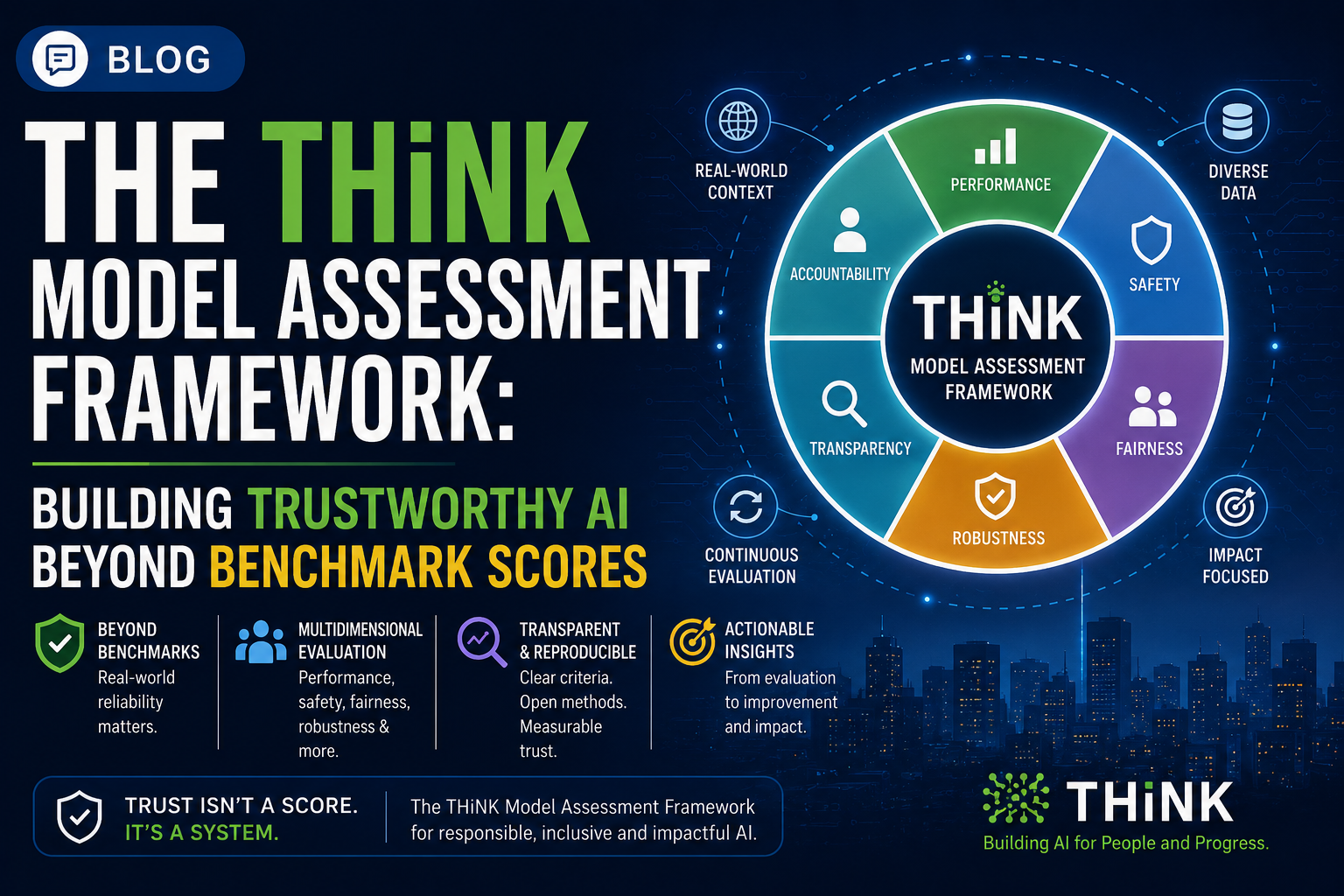
The THiNK-ARIES (Artificial Intelligence Risk Evaluation and Security) Bot Testing Framework is an evidence-driven methodology for establishing trust in AI-powered conversational systems and autonomous agents. It provides organizations with a structured mechanism to answer a fundamental question: "Can this AI system be trusted to operate safely, securely, and responsibly?"
Unlike traditional testing that focuses on deterministic correctness, THiNK-ARIES evaluates trustworthiness across multiple dimensions—Security, Reliability, Privacy, Fairness, Reasoning, and Autonomy, using a risk-centric philosophy that allocates testing resources based on operational impact. The framework guides AI systems through a complete assessment lifecycle, employing a Test Selection Engine that automatically prioritizes relevant assessments, a Pass/Fail Decision Engine with five standardized outcomes to capture probabilistic AI behavior, and a Trust Scoring Engine that produces transparent, multidimensional scores. An integrated Evidence Model ensures every finding is fully traceable to verifiable artifacts, enabling auditability and root cause analysis.
Vendor-neutral, model-agnostic, and extensible, THiNK-ARIES provides a repeatable, defensible approach to AI assurance that empowers organizations to make informed deployment decisions, maintain regulatory compliance, and build lasting confidence in their AI systems.
Example: The NIST AI Risk Management Framework and Agentic AI
The NIST AI Risk Management Framework (AI RMF) provides foundational principles for AI governance. But agentic AI requires more. Researchers have proposed a new adaptation of the NIST Cybersecurity Framework (CSF) 2.0 specifically for agentic AI, guiding organizations in identifying, protecting, responding to, and recovering from risks.
The Agentic AI Profile, developed by the Center for Long-Term Cybersecurity, organizes guidance around the four core functions of the NIST AI RMF: Govern, Map, Measure, and Manage. Meanwhile, AAGATE (Agentic AI Governance Assurance & Trust Engine) translates these high-level functions into deployable operational controls.
Example: The Agentic AI Governance Framework
A 2025 working paper introduced a practical, platform-agnostic governance model designed to bridge the gap between high-level compliance principles and deployable operational controls. It defines six governance principles:
- Pre-deployment validation, testing agents before they go live
- Runtime monitoring, watching agents in action
- Human-in-the-loop escalation, bringing humans in for critical decisions
- Multi-agent accountability, tracking responsibility across agent teams
- Tool-calling access control, limiting what tools agents can use
- Continuous evaluation, ongoing assessment and improvement
A key contribution is the Agentic Log Retention Index (ALRI) , a quantitative heuristic for determining audit-grade log retention based on agent autonomy, risk exposure, and jurisdictional requirements.
Example: The World Economic Forum's Agentic AI Playbook
In May 2026, the World Economic Forum released AI Agents in Action: A Playbook for Trusted Adoption, Authorization and Scaling. It introduces the Agent Capability and Authorization Profile (ACAP) , a deployment-level governance and authorization instrument that makes delegated decisions and actions auditable, enforceable, and accountable across the full lifecycle. The report provides organizations with a structured path from pilots to portfolios of governed agents at scale.
Practical Takeaways
Tip 1: Anchor to recognized standards. Start with ISO/IEC 42001 for management systems, use IEEE 7000 for ethical design, and conduct impact assessments with ISO/IEC 42005. Standards provide a proven foundation that saves you from reinventing the wheel.
Tip 2: Build governance into the architecture, not as an afterthought. Governance should be a layered architecture that oversees the full ecosystem, context, models, agents, tools, interfaces, and the people who interact with them. As one framework puts it: "let the model reason, but never let it execute unchecked".
Tip 3: Implement the "Three Pillars" of agentic governance. Singapore's framework recommends: (1) assess and bound risks, (2) ensure meaningful human accountability, and (3) implement technical controls and processes. This means clear decision rights based on how much freedom an agent has, real-time monitoring to track AI behavior, and escalation paths so high-impact decisions automatically go to humans.
Tip 4: Treat agentic AI as an identity and access problem. With machine identities now outnumbering humans 109 to 1, assign unique identities to every agent and tool; authorize actions with least privilege and short-lived credentials; contain autonomy through sandboxing and resource limits; and instrument every step with standardized telemetry.
Tip 5: Embed ethics from the start. Use frameworks like COMPASS to enforce value-aligned AI through modular governance mechanisms. Ethics isn't a checkbox, it's a continuous process of alignment, evaluation, and adjustment.
Conclusion
The era of agentic AI is not coming, it's here. Autonomous agents are already making decisions, taking actions, and reshaping how organizations operate. But with great capability comes great responsibility.
The good news is that we don't have to navigate this alone. A rich ecosystem of standards, ethical frameworks, and governance models is emerging to guide us: ISO/IEC 42001, Singapore's MGF for Agentic AI, the OWASP Top 10 for Agentic Applications, the NIST AI RMF, the WEF's ACAP framework, and many more. These are not bureaucratic obstacles, they are essential guardrails that enable innovation while protecting people, organizations, and societies.
The question is no longer whether to adopt agentic AI. The question is whether we will adopt it responsibly.
Resources to Read More
Frameworks & Standards
- ISO/IEC 42001:2023 , AI Management Systems
- Singapore Model AI Governance Framework for Agentic AI (2026)
- OWASP Top 10 for Agentic Applications (2025/2026)
- NIST AI Risk Management Framework (AI RMF)
- WEF AI Agents in Action: A Playbook for Trusted Adoption
Academic Papers
- COMPASS: The explainable agentic framework for Sovereignty, Sustainability, Compliance, and Ethics
- Agentic AI Governance Framework (Zenodo, December 2025)
- A Safety and Security Framework for Real-World Agentic Systems
Governance Resources
- Agentic AI Governance: A Layered Architecture Approach
- The Agentic Risk & Capability (ARC) Framework
- AAGATE: A NIST AI RMF-Aligned Governance Platform
Call to Action
Agentic AI is transforming how organizations operate, but only if we govern it responsibly. Share this post to help others understand the importance of standards, ethics, and governance in the age of autonomous AI. What's your organization doing to govern agentic AI? Drop a comment below, let's learn from each other.
Written by:
THiNK LAB.